
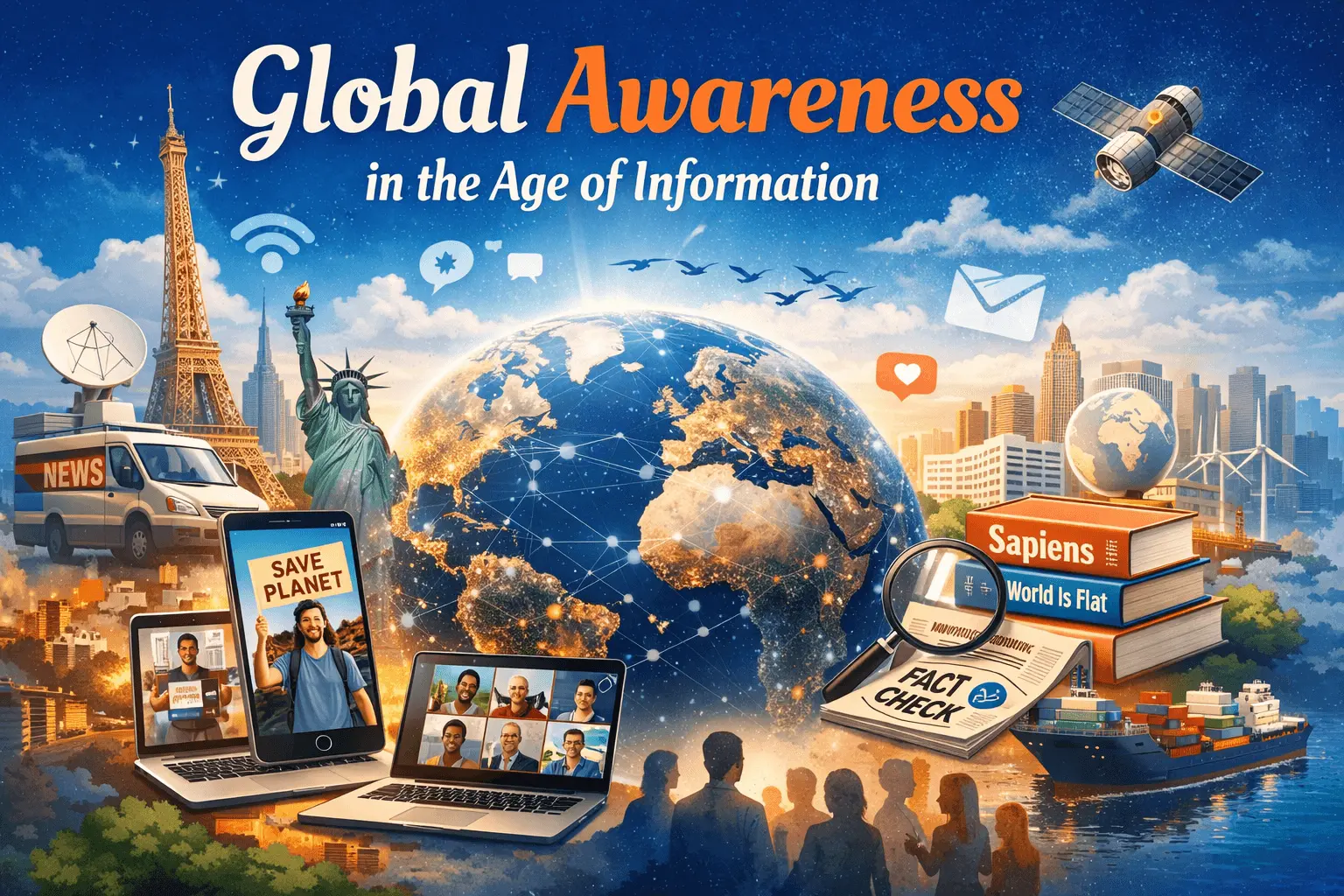
We live in a time when information travels across the globe in seconds. A news story breaking in New York City, a technological innovation in Tokyo, or a social movement emerging in Cape Town can instantly reach millions of people around the world. This rapid flow of information has transformed how individuals understand global events, cultures, and challenges.
The modern era, often called the Information Age, has significantly increased global awareness—the ability to understand and engage with issues that extend beyond local communities. Through the internet, digital media, and global communication networks, people today are more connected to worldwide developments than at any other time in history.
Rise of the Information Age
The growth of the internet and smartphones has reshaped how societies consume information. Platforms such as Google, Meta Platforms, and X Corp. allow users to access real-time updates from nearly every part of the world. News organizations including BBC, CNN, and Al Jazeera Media Network broadcast international stories that help audiences understand global perspectives.
Books have also played an important role in shaping discussions about globalization and information. Works like The World Is Flat by Thomas L. Friedman explore how technology has made the world more interconnected, while Sapiens: A Brief History of Humankind by Yuval Noah Harari discusses the broader evolution of human societies and shared knowledge.
These technological and intellectual developments have created an environment where global conversations are not limited to governments or institutions. Individuals now have the ability to participate in discussions about international issues, cultures, and opportunities.
Benefits of Global Awareness
One of the greatest advantages of living in the information age is the ability to develop a deeper understanding of global issues. Events such as climate change discussions at the United Nations or international economic forums like the World Economic Forum often receive worldwide attention and spark dialogue among citizens from different countries.
Global awareness also encourages cultural understanding. For example, someone in Paris can easily learn about traditions in Kyoto, while students in Delhi may study art, literature, or music from many parts of the world. Digital platforms have made it possible to explore diverse cultures without leaving one’s home.
Another benefit is increased collaboration across borders. Researchers, entrepreneurs, and creative professionals frequently connect online to share ideas, launch projects, and support international causes. Global awareness fosters empathy and cooperation, helping societies address challenges that affect humanity as a whole.
Challenges of Too Much Information
While the information age offers remarkable opportunities, it also presents new challenges. One major concern is the spread of misinformation or misleading content. Because information travels quickly across social networks, false or inaccurate stories can reach large audiences before they are verified.
Information overload is another issue. With thousands of news updates, social media posts, and online articles appearing every day, individuals may find it difficult to identify reliable sources. Critical thinking and media literacy have therefore become essential skills for navigating today’s digital landscape.
Experts often encourage readers to consult credible publications such as The New York Times or The Guardian, and to compare multiple perspectives before forming conclusions about global events.
Global Entrepreneurship and Digital Opportunities
The information age has also expanded opportunities for global entrepreneurship. Digital marketplaces allow creators, designers, and small businesses to reach international audiences without traditional barriers. Platforms like Designhill, for example, enable individuals and businesses to design and customize products such as clothing and merchandise while connecting with customers from different parts of the world.
This shift reflects a broader trend in digital commerce. Companies such as Shopify, Etsy, and Amazon have helped entrepreneurs build global businesses through online storefronts and creative marketplaces. Designers in one country can collaborate with clients in another, demonstrating how information and technology are reshaping economic opportunities.
Technology and the Future of Global Awareness
Emerging technologies are likely to deepen global awareness even further. Artificial intelligence, real-time translation tools, and virtual communication platforms are making it easier for people from different cultures to share knowledge and ideas.
Educational institutions and digital learning platforms are also expanding access to global perspectives. Universities such as Harvard University and University of Oxford now offer online courses that allow students worldwide to participate in discussions about science, history, and global policy.
As these technologies evolve, they may help individuals become more informed citizens capable of understanding complex global challenges.
Conclusion
Global awareness in the age of information reflects a profound transformation in how societies interact with knowledge and with one another. From international news networks to online creative platforms, the tools available today allow individuals to learn about distant cultures, follow global developments, and participate in worldwide conversations.
However, with this unprecedented access to information comes responsibility. People must evaluate sources carefully, think critically about the content they encounter, and remain open to diverse perspectives. By doing so, the information age can continue to promote understanding, cooperation, and meaningful connections across the world.