

- Definition of HRM: The management process focused on developing and managing the human element within an enterprise.
- Core Function: A management role designed to assist managers in identifying and placing the right individual in the appropriate job.
- Organizational Impact: HRM addresses the “people dimension,” recognizing that an organization’s market reputation is built by its employees.
- Functional Scope: Focuses on recruitment, management, and providing strategic direction for the workforce.
- Holistic Management: Extends beyond technical skills to manage the attitudes, aspirations, and behaviors of people.
- 2026 Strategic Evolution: In the current 2026 landscape, HRM has transitioned from administrative “personnel management” to a strategic pillar utilizing Agentic AI and predictive analytics to drive organizational culture and growth.
- Modern Skill-Based Approach: Contemporary 2026 practices prioritize skills-based hiring over traditional degree-led credentials to match capabilities directly with business outcomes.
- Technological Integration: Recent techniques involve the use of AI-powered HR tools for automated resume screening, predictive attrition analysis, and personalized employee experience design.
- Well-being and Performance: Current management trends emphasize holistic employee well-being—including mental and financial health—as a direct driver of productivity and engagement.
- Continuous Development: Modern HRM focuses on continuous learning ecosystems and “microlearning” to proactively reskill employees in response to rapid technological shifts.
Also Read: History of Human Resource Management
Evolution of Human Resource Management
The evolution of human resource management has developed through the following Stages.
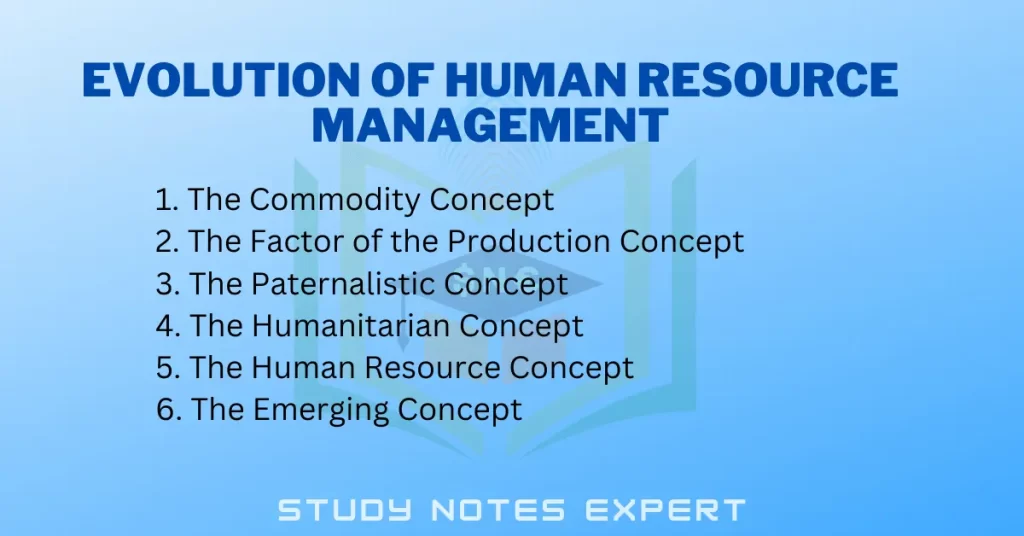
1. The Commodity Concept
- Guild System: Represented the earliest foundations of Human Resource Management prior to the Industrial Revolution.
- Core Functions of Guilds: Managed the selection, training, compensation, and general maintenance of workers within closely knit groups.
- Impact of Industrialization: Triggered a separation between owners and managers, dissolving the previously close relationships with employees.
- Commodity Concept: Shifted the perception of labor into a marketable commodity intended to be bought and sold.
- HRM Evolution: These transitions from communal craft groups to industrialized labor markets mark the historical development of modern HRM practices.
2. The Factor of the Production Concept
- Conceptual Framework: Defines employees as a primary factor of production, analogous to land, materials, and machinery.
- Scientific Management Influence: Employs Frederick Taylor’s principles, emphasizing systematic selection and rigorous training to optimize organizational productivity.
- Operational Perception: Characterizes the workforce as functional components of mechanical systems or subordinate appendages within the manufacturing process.
- Economic and Environmental Impact: Represents an evolutionary advancement in labor relations by facilitating enhanced working conditions and increased earning potential for the workforce.
3. The Paternalistic Concept
- Historical Context of Collective Action: Employees coalesced around shared interests to establish trade unions aimed at enhancing their socio-economic status.
- Impact of Democratic Expansion: The proliferation of democratic principles provided the necessary momentum for the development and implementation of collective bargaining processes.
- Role of the State: Government entities formally acknowledged and institutionalized the right of workers to receive protection within the scope of their employment.
- Evolutionary Milestone: These converging socio-political forces represent a primary stage in the historical evolution of Human Resource Management (HRM).
- Implementation of Welfare Schemes: Employers adopted a paternalistic and protective posture toward their workforce, resulting in the provision of various support mechanisms.
- Scope of Provisions: Paternalistic welfare initiatives typically encompassed health services, recreational facilities, pension frameworks, and group insurance schemes.
- Mutual Dependency: A paradigm shift occurred wherein both employers and employees recognized that organizational prosperity and survival are contingent upon mutual cooperation.
4. The Humanitarian Concept
- Evolution of HRM in India: The humanitarian concept represents a significant developmental phase in the evolution of Human Resource Management within the Indian industrial context.
- Shift from Paternalism: In contrast to the paternalistic approach where benefits are viewed as employer favors, the humanitarian system recognizes employees’ unalienable rights as human beings.
- Employer Responsibility: Management is fundamentally obligated to acknowledge and protect the inherent rights of the workforce.
- Multi-dimensional Motivation: Insights from industrial psychology indicate that employees are not exclusively motivated by material or financial rewards.
- Psychological and Social Variables: Achieving workplace efficiency requires addressing the social and psychological satisfaction of the individual.
- The Hawthorne Experiments: Research, specifically the Hawthorne experiments, redirected industrial focus toward human-generated problems and social dynamics within the workplace.
- Human Relations Concept: Due to its emphasis on interpersonal dynamics and worker well-being, this approach is formally designated as the human relations concept.
5. The Human Resource Concept
- Implementation of Behavioral Science: Utilization of scientific principles to analyze and address challenges regarding individual and collective human behavior within the workplace.
- Emergence of Key Behavioral Concepts: Integration of motivation, group dynamics, organizational climate, and organizational conflict as fundamental theoretical frameworks.
- Human Capital Valuation: Conceptualization of employees as indispensable organizational assets rather than mere labor inputs.
- Goal Alignment and Integration: Strategic efforts to synchronize individual employee objectives with broader organizational goals for mutual achievement.
- Evolution of Management Practices: Transition toward participatory methodologies, including two-way communication, Management by Objectives (MBO), and the formal recognition of informal groups.
- Quality Circles: Adoption of collaborative problem-solving groups to enhance operational efficiency and output quality.
- Foundational Impact on HRM: The human resource concept serves as a critical developmental stage in the historical evolution of modern Human Resource Management.
6. The Emerging Concept
- Evolution of Employee Status: Organizational paradigms are shifting to view employees as strategic partners within the industry rather than mere subordinates.
- Financial Integration: Personnel are increasingly integrated into corporate ownership through the allocation of company stock memberships and share equity.
- Governance Participation: Labor representatives are being systematically appointed to boards of directors to facilitate worker involvement in high-level decision-making.
- Psychological Ownership: These structural shifts are designed to foster a sense of organizational belonging and personal investment among the workforce.
- Academic and Professional Formalization: Human Resource Management (HRM) is transitioning into a rigorous academic discipline and a distinct, regulated profession.
- Specialized Career Pathways: The field is expanding into specialized domains, including Human Resource Development (HRD) and Industrial Relations.
Conclusion
In this write-up, we have discussed the complete stages in the evolution of human resource management. HRM began as a record-keeping function. Later on, the administration of labor agreements became its primary task. After some time, the focus shifted to the scientific aspect involving systematic techniques for employee selection, training & Compensation. On the other hand, the emerging concept looks upon them as a resource, an asset & an opportunity.
How Many Stages are there in Evolution of HRM?
The evolution of human resource management has developed through the following 5 Stages.
1. The Commodity Concept
2. The Factor of the Production Concept
3. The Paternalistic Concept
4. The Humanitarian Concept
5. The Human Resource Concept
6. The Emerging Concept
How was the Evolution of HRM in India?
At the beginning of the 20th century, the initial viewpoint was the end of exploitation. As a result, many legal measures were taken by the Government. It gave birth to a vital concept of HRM. Later, developments showed the tendency of a positive attitude toward the welfare of the employees. In a nutshell, the evolution of human resource management helps us identify human resource management as a profession.
I appreciate the clear explanations in this tutorial.